 Large Image
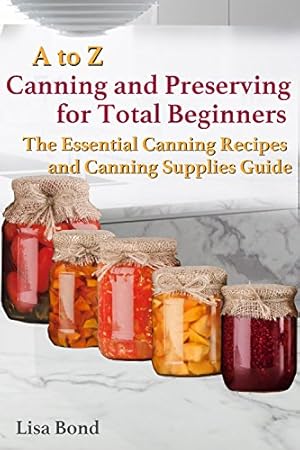
A to Z Canning and Preserving for Total Beginners : The Essential Canning Recipes and Canning Supplies Guide

Share This
Description
Food that last forever
Includes links to 50 Healthy Mexican Recipe Videos
Preserving food to last through the cold months or packaging or bottling it to travel long distances has long been a concern. Napoleon stated, "An army travels on its stomach." He was referring to the problems involved with transporting sufficient food to keep his men fed. The Napoleonic soldiers were often hungry, thanks to the difficulty of transporting fresh food. Just to show that he was serious about solving this problem, he offered a reward of 12,000 francs to anyone who could come up with a solution.
The award was given to Nicholas Appert in 1810. After trying a variety of methods - including attempting to remove air from his glass jars - he devised a method that worked. The food was placed in a glass bottle, then corked and sealed with wax. The glass bottles were then wrapped in canvas, and boiled in water. The result was bottled foodstuffs that could be transported, even though the jars were breakable. Appert published a book titled, The Art of Preserving Animal and Vegetable Substances.
Two years later, Brian Donkin found a way to substitute tin for the fragile glass, and the canning industry was born. It made its way to American, where Gail Borden used the technique to preserve milk so it could be transported to the inner cities.
There were problems along the way with this journey toward portable food preservation. The first was the sealant used on the cans. The early ones were soldered closed using lead solder. Of course, if you are on a battlefield where you could be shot down at any minute, lead poisoning probably isn't high on your list of worries. Second, it took forty years before anyone invented a can opener. Napoleon's men were forced to use their swords to open the cans, a process that probably didn't do the sword any good, and no doubt was less than satisfactory for getting those cans opened without spilling the contents.
Readers might be wondering at this point why modern home canning is usually done in glass jars, following methods that are similar to the ones Appert developed. The answer is somewhat complex.
Canning in metal requires more specialized equipment than canning in jars. Once the cans are filled, the lids must be sealed on. The cans will then need to be heated to destroy bacteria. (The first ones were made fifty years before Louis Pasteur did his ground-breaking work, so neither Appert or Donkin knew why it was that some cans would be just fine, while others would spoil. In early canning efforts, if the can was sealed and did not bulge, it was presumed to be safe to eat. No one knew about botulism, that hidden killer that can lurk in an improperly bottled jar of green beans.
The equipment for canning in tins is more expensive than that needed to can in glass bottles. It is also easier to see if the food is still good when it is preserved in transparent glass. Incidentally, "can" is short for "canister." As we all know, canisters can be made from all sorts of materials, so if you've ever wondered why foodstuffs preserved in glass jars was said to the "canned," rather than "bottled", that is the explanation.
Since this is a book about the very basics of home canning, it only addresses putting up your food in glass. Preserving food in metal cylinders requires a specialized sealer is a technique for experienced food preservers.
Tag This Book
This Book Has Been Tagged
Our Recommendation
Notify Me When The Price...
Log In to track this book on eReaderIQ.
Track These Authors
Log In to track Lisa Bond on eReaderIQ.